Introduction
When selecting a servo voltage stabilizer for an industrial plant, one common assumption is simple: if a 100 KVA stabilizer provides protection, then a 500 KVA or 1000 KVA model must provide even better protection. But is that actually true?
The answer is no—not necessarily. A servo stabilizer should be selected according to the connected load, voltage requirements, operating conditions, future expansion plans, and required safety margin. Choosing a much larger KVA rating than your actual requirement does not automatically improve voltage regulation or equipment protection.
In fact, selecting the right KVA capacity is more important than simply selecting the biggest available model.
So, What Does KVA Actually Tell You?
KVA, or kilovolt-ampere, represents the apparent power-handling capacity of an electrical system. In a servo stabilizer, the KVA rating indicates approximately how much electrical load the unit is designed to handle under specified operating conditions.
For example, a 100 KVA servo stabilizer is designed for a substantially different load requirement than a 500 KVA or 1000 KVA unit.
| Stabilizer Rating | Typical Requirement | Possible Application |
|---|---|---|
| 20–50 KVA | Small to moderate loads | Small industrial equipment, offices, commercial installations |
| 100–200 KVA | Medium industrial loads | Machinery, workshops, production equipment |
| 300–500 KVA | Heavy industrial loads | Manufacturing plants, large machinery |
| 750–1000 KVA | High electrical loads | Large industrial installations |
| 1500–2500 KVA | Very high-capacity requirements | Large plants and heavy industrial applications |
These are general capacity categories rather than universal sizing rules. The actual requirement should always be calculated from the site's electrical load.
Why Doesn't a Bigger Stabilizer Automatically Mean Better Protection?
A stabilizer's KVA rating primarily describes its capacity. It does not, by itself, determine every aspect of its voltage-regulation performance.
A properly selected servo voltage stabilizer combines the required capacity with appropriate input range, output regulation, response characteristics, cooling arrangement, protection features, and installation design.
Consider a factory whose calculated requirement is around 180 KVA. Installing a 1000 KVA stabilizer simply because it is larger does not automatically mean the connected machinery will receive better voltage regulation.
The better approach is to select a suitable rating with an appropriate operating margin based on the actual load profile and future requirements.
What Happens If You Choose a Stabilizer That Is Too Small?
This is where incorrect KVA selection can become a serious problem. If the connected load consistently exceeds the stabilizer's rated capacity, the unit may operate under excessive stress.
Depending on the installation and protection design, an undersized stabilizer may experience:
- Overloading
- Excessive heating
- Reduced operating efficiency
- Frequent protection trips
- Unstable operation during high-load periods
- Reduced equipment reliability
For this reason, selecting a stabilizer with insufficient capacity can be much more problematic than simply choosing a larger suitable model.
But Can You Go Too Big With KVA?
Yes. Oversizing is not necessarily dangerous in the same way as undersizing, but it can be inefficient from a purchasing and system-design perspective.
If a facility needs approximately 200 KVA and installs a significantly oversized unit without a practical reason, the additional capacity may not provide proportional benefits.
There may also be higher upfront equipment costs, larger physical dimensions, and additional installation requirements.
The objective should therefore be correct sizing with an appropriate safety margin, rather than choosing the maximum KVA available.
What Should You Check Before Deciding the KVA Rating?
Instead of asking, “What is the biggest stabilizer I can buy?”, ask a more useful question: “What is the actual electrical load my stabilizer needs to handle?”
Several factors should be considered.
1. Connected Load
Start by identifying the total electrical load that will be connected to the stabilizer. This may include motors, CNC machines, compressors, pumps, lighting systems, production equipment, and other electrical loads.
2. Motor Starting Loads
Industrial motors can have substantially higher starting current than their normal running current. The effect of starting loads should therefore be considered during stabilizer selection.
3. Future Expansion
If the plant is planning to add machinery, the stabilizer should be selected with the expected future load in mind. This can prevent the need for immediate replacement when production capacity increases.
4. Input Voltage Range
The incoming voltage variation is another important consideration. A stabilizer must be suitable for the actual voltage conditions at the installation site.
5. Output Voltage Requirement
Different types of equipment may have specific voltage requirements. The stabilizer should be selected according to the required output voltage and the electrical configuration of the facility.
6. Phase Configuration
Industrial applications may require single-phase or three-phase servo stabilizers. The phase arrangement should match the electrical system and connected equipment.
Does a 500 KVA Stabilizer Protect Better Than a 100 KVA Model?
Not simply because its rating is higher.
A 500 KVA servo stabilizer can handle a much larger load than a 100 KVA unit, assuming both are designed for comparable operating conditions. But if the actual load is only 80–100 KVA, the 500 KVA rating does not automatically provide better voltage regulation just because the number is larger.
Think of KVA as capacity rather than a protection score.
| Factor | Why It Matters |
|---|---|
| KVA Rating | Determines the load-handling capacity |
| Input Voltage Range | Determines the voltage variation the stabilizer can accommodate |
| Output Regulation | Determines how closely the output can be maintained around the required voltage |
| Response Time | Indicates how quickly the system responds to voltage changes |
| Cooling System | Helps manage heat during operation |
| Protection Features | Helps safeguard the stabilizer and connected system under specified fault conditions |
| Installation | Proper wiring, load distribution, and environment affect performance |
Air Cooled or Oil Cooled: Does KVA Decide Everything?
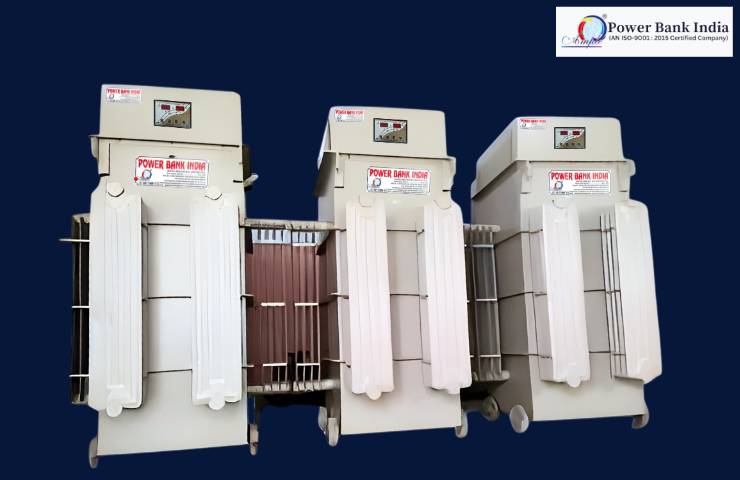
KVA capacity and cooling method are two different considerations. Depending on the application and rating, businesses may consider air cooled servo stabilizers or oil cooled servo stabilizers.
Air cooling can be suitable for various installations where the operating environment and capacity requirements allow it. Oil cooling is commonly considered for larger or heavy-duty installations where heat management and operating conditions make it appropriate.
The cooling arrangement should therefore be evaluated together with the KVA requirement rather than treating KVA as the only selection factor.
When Does a Higher KVA Rating Actually Make Sense?
A higher KVA rating can be beneficial when the facility genuinely has a larger electrical requirement.
For example, a manufacturing plant may begin with a 300 KVA load but plan to install several additional production machines. In such a case, selecting a higher capacity stabilizer may provide useful headroom for planned expansion.
Higher-capacity stabilizers can also be appropriate for facilities with substantial industrial loads, provided the capacity is supported by proper load calculations and system design.
How Can You Estimate the Right Stabilizer Capacity?
A simplified approach is to determine the total connected load and then consider the actual operating pattern, starting currents, power factor, load diversity, and planned expansion.
For three-phase systems, electrical engineers commonly use the relationship between apparent power, line voltage, and current when calculating system capacity:
KVA = √3 × Voltage × Current ÷ 1000
For single-phase systems, the corresponding relationship is:
KVA = Voltage × Current ÷ 1000
These formulas provide a starting point for calculating apparent power. Actual stabilizer selection should account for the characteristics of the connected equipment and the manufacturer's technical specifications.
What Is the Biggest Mistake Buyers Make?
One of the biggest mistakes is selecting a stabilizer based only on the number printed on the nameplate.
A buyer may compare a 100 KVA, 300 KVA, 500 KVA, and 1000 KVA servo stabilizer and assume that the highest rating is automatically the best option.
Instead, the selection should begin with:
- Total connected load
- Maximum operating load
- Motor and equipment starting requirements
- Input voltage variation
- Required output voltage
- Phase configuration
- Future expansion
- Installation environment
- Required protection features
This approach makes the purchase more technically meaningful and can prevent unnecessary oversizing.
So, What Is More Important: Bigger KVA or Correct KVA?
Correct KVA is more important.
A servo stabilizer should have enough capacity to handle the actual electrical load while providing a sensible margin for operating variations and planned expansion. Going smaller than the requirement can create operating problems, while going excessively larger may increase costs without providing a proportional improvement in protection.
The ideal solution is therefore not the biggest stabilizer—it is the right-sized servo stabilizer with suitable technical specifications.
A Simple Example: Choosing Between 100 KVA and 500 KVA
Suppose an industrial facility has a calculated operating requirement of approximately 85 KVA, with a reasonable allowance for future load growth.
Choosing a suitable capacity around the expected load may be more practical than immediately installing a 500 KVA unit.
Now consider a manufacturing plant whose operating load is already around 400 KVA and is expected to increase. In that situation, a 500 KVA or higher-capacity servo stabilizer may be more appropriate, subject to detailed electrical assessment.
The difference between these examples demonstrates why KVA selection should be based on the application rather than simply choosing the largest model.
What Should the Final Selection Look Like?
A well-selected industrial servo stabilizer should match the electrical requirements of the facility rather than simply exceed them by a huge margin.
Before finalizing a model, compare the required KVA capacity with its input voltage range, output voltage, regulation accuracy, response characteristics, cooling method, efficiency, protection features, and installation requirements.
For large industrial applications, professional electrical assessment is recommended before selecting the final stabilizer rating.
FAQs
Does a higher KVA servo stabilizer provide better protection? Not necessarily; the stabilizer should be correctly sized for the connected electrical load.
What happens if a servo stabilizer is undersized? It may experience overloading, heating, frequent trips, and reduced reliability.
Is it bad to oversize a servo stabilizer? Oversizing may increase equipment and installation costs without providing proportional benefits.
How do I choose the right KVA stabilizer? Consider connected load, starting current, input voltage, output requirement, phase configuration, and future expansion.
Is a 500 KVA stabilizer better than a 100 KVA stabilizer? A 500 KVA unit can handle a larger load, but it is not automatically a better choice for a facility requiring only 100 KVA.
The Right Stabilizer Is About More Than a Bigger Number
A bigger KVA rating does not automatically mean better voltage protection. KVA tells you how much apparent power the stabilizer is designed to handle, while overall suitability depends on several technical factors.
For industrial facilities, the goal should be to choose a stabilizer that matches the electrical load, accommodates realistic operating conditions, provides an appropriate margin for future requirements, and includes the technical features needed for the application.
Whether the requirement is a 100 KVA, 300 KVA, 500 KVA, 1000 KVA, 1500 KVA, 2000 KVA, or 2500 KVA servo stabilizer, the best choice is the one that is correctly matched to the installation—not simply the one with the highest number.